
 Synch AI
Travel Agency Supplier Payments and Deadlines: A Complete Guide
Learn how travel agencies can manage supplier payments and deadlines, avoid late fees, and track every due date with a simple step-by-step system.

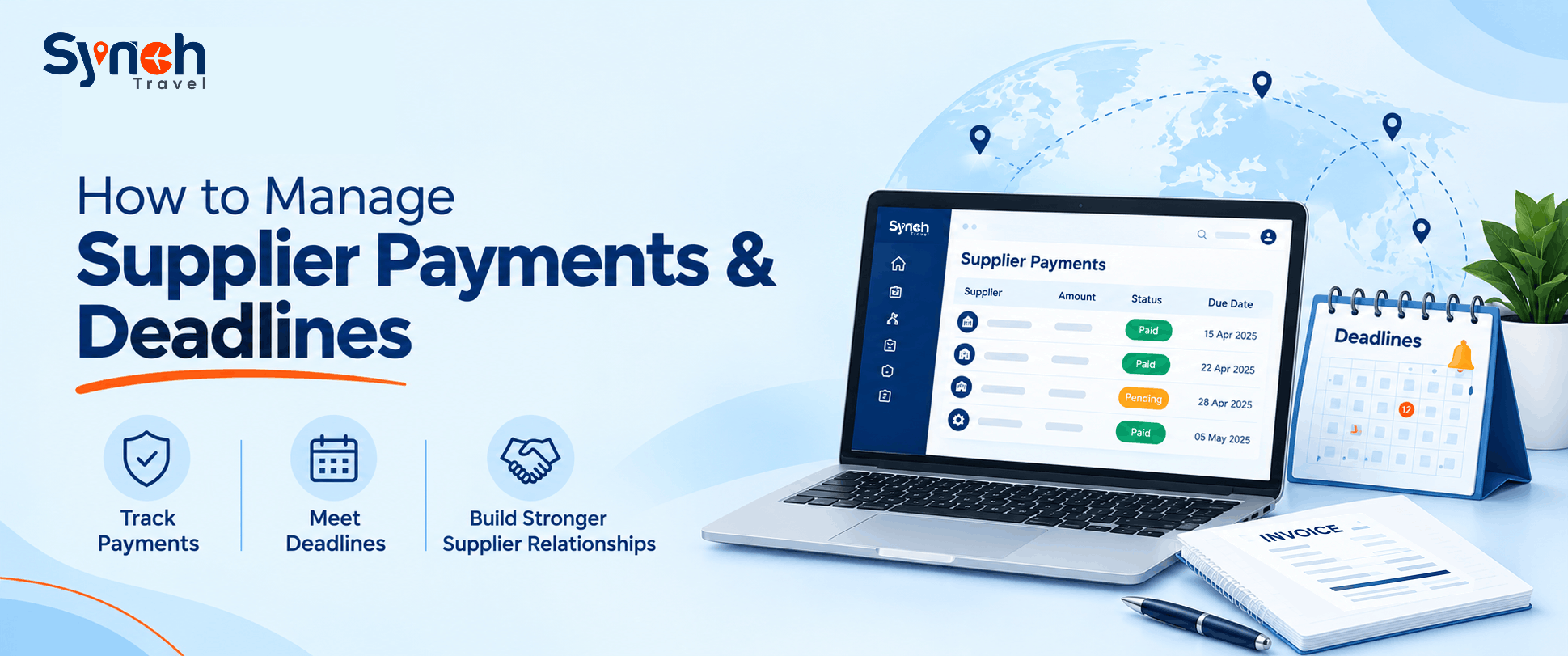
Managing supplier payments is not just about knowing how much your agency owes. It is about knowing which payments are due, what remains outstanding, and how each obligation affects an active booking.
With multiple suppliers, customer instalments, payment deadlines, and hotel option expiry dates to manage, keeping everything up to date can become increasingly difficult. When information is spread across spreadsheets, emails, and separate records, your team may struggle to identify what needs attention first.
An effective payment management process brings supplier costs, payments, outstanding balances, and important dates together at booking level.
This guide explores the common challenges of supplier payment tracking, practical ways to improve your processes, and how travel management software like SynchTravel can help your team stay organized.
In simple terms: Supplier payment tracking is the process of recording what a travel agency owes each supplier, what has been paid, what remains outstanding, and when each payment is due, with the information linked to the relevant booking.
What Can Go Wrong When Supplier Payments Are Tracked Manually?
Manual tracking can work well when booking volumes are low. As bookings and supplier payment deadlines increase, keeping everything up to date becomes more difficult. At this stage, supplier payment tracking software for travel agents can help organize payment records and booking details in one place.
Payment Details Are Scattered Across Multiple Records
One person may update a spreadsheet, and another may record a payment against the booking, while supplier emails contain the latest payment instructions or deadlines.
The information exists, but it isn't necessarily in one place.
Outstanding Supplier Balances Are Difficult to Track
When a supplier asks for an update, staff may need to check the booking, payment history, and bank records before confirming the outstanding balance. If several installments have been paid, even a simple query can require repeated checking.
This takes time away from customer enquiries and following up on upcoming payments.
Hotel Options Can Expire Before Your Team Acts
An option booking is not the same as a confirmed booking.
A hotel may hold a room until a particular date or time, after which the room or rate may no longer be available. If the expiry date is not visible to the person managing the booking, an otherwise useful option can disappear simply because nobody acted in time.
For agencies handling a high volume of hotel bookings, hotel option expiry date tracking can therefore be just as important as monitoring supplier payments.
What Details Should Travel Agencies Record for Each Supplier Payment?
To manage supplier payments accurately, your team needs clear records of the supplier, agreed cost, payments made, outstanding balance, and due date for each booking.
Track the following details:
- Booking details: Which customer and booking does the payment relate to?
- Supplier: Who needs to be paid?
- Service: Which hotel, transfer, tour, or other travel service does the payment cover?
- Supplier cost: What is the total agreed cost?
- Amount paid: How much has already been paid?
- Outstanding balance: How much remains payable?
- Payment due date: When must the supplier receive payment?
- Hotel option expiry date: When does a held room or rate expire?
- Customer payment status: How much has the customer paid, and what remains due from them?
Keeping these details accessible helps staff answer supplier queries, review upcoming payments, and identify outstanding amounts without piecing together information from separate records.
How Can Travel Agencies Improve Supplier Payment Management?
A reliable process starts with recording supplier costs, payment terms, amounts paid, outstanding balances, and due dates against each booking. When multiple suppliers are involved, create a separate record for each payment obligation.
Staff should review upcoming payments, overdue balances, and hotel option expiry dates regularly rather than waiting for a supplier to chase an unpaid amount. Update every payment against the relevant record once confirmed, and retain supporting documents for reference.
Responsibility matters, too. Assigning payment follow-ups to specific team members helps prevent important actions from being overlooked, especially when another employee needs to take over a booking.
Finally, review customer receipts and supplier obligations together. This helps the agency understand what has been collected, what remains payable, and where a payment needs attention.
These steps can help your team manage supplier payments, but as bookings increase, tracking every outstanding balance and payment deadline becomes harder.
To manage this process more effectively, you need a travel technology partner that understands how bookings, customer payments, and supplier commitments fit together. Synch Travel brings booking management and financial activity together, with tools to track supplier payments, monitor outstanding balances, and receive alerts when payments or other actions are due.
How SynchTravel Helps Manage Supplier Payments
When your agency handles multiple bookings, you need to know more than which payments have been made. You also need to check outstanding supplier balances, review upcoming payment dates, and act before hotel options expire.
SynchTravel connects supplier payment information to relevant booking details, helping your team understand what's been paid, what remains due, and what needs attention.
Track Supplier Payments Against Each Booking
Keep supplier payment information associated with the relevant booking, customer, and supplier. Your team can check payment details in context instead of searching through separate records to understand a booking's financial position.
Know What You Still Owe Each Supplier
Track payments made and outstanding balances for each booking. This is particularly useful when a booking includes multiple services or supplier payments are made in instalments. It also helps agencies assess travel agency software with payment tracking against their day-to-day needs.
How to Avoid Missing Supplier Payment Due Dates in Travel
Track supplier payment due dates alongside the booking to make upcoming obligations easier for staff to review. This gives the team a clearer list of what needs attention, rather than burying important dates in emails or individual notes.
Hotel Option Expiry Date Tracking: How to Know What's Due
Hotel options can expire before a customer confirms their booking. Keeping the expiry date visible alongside the relevant booking helps your team follow up with the customer, confirm the reservation, or release the option before the deadline.
Supplier Payment Reminders for Travel Agents
Payment dates and hotel option deadlines can be difficult to manage when staff rely on memory or scattered notes. A consistent review process, supported by reminders where available, helps your team identify upcoming tasks and follow up in time.
Customer Payments and Supplier Payments Should Be in One Place
Another side of supplier payment management that agencies cannot ignore is the gap between when the customer pays and when the supplier needs to be paid.
For example: A customer books a $4,000 trip and pays a $1,000 deposit. The hotel supplier owes $2,000 within 30 days.
- Total booking value: $4,000
- Customer deposit received: $1,000
- Customer balance remaining: $3,000
- Hotel payment due: $2,000 within 30 days
The agency still needs to collect $3,000 from the customer, while $2,000 must be paid to the hotel before that balance is received.
Example figures are for illustration only.
This is why a confirmed booking isn't enough. Your team needs to see what the customer has paid, what remains outstanding, what the supplier is owed, and when payment is due.
Synch Travel keeps this payment information linked to the booking, giving your team a clearer view of the money coming in, the money going out, and what needs attention next.
A Better Supplier Payment Process for a Travel Agency
A practical process doesn't need to be complicated.
It should give the team a consistent way to manage the financial side of every booking.
- Create the booking: Record the customer, services, and relevant booking information.
- Record supplier costs: Add the supplier cost and payment requirements for the services included in the booking.
- Track customer payments: Track deposits, installments, and remaining customer balances.
- Record supplier payments: As payments are made, update the amount paid against the relevant supplier and booking. This also gives the team a clear record for supplier invoice processing and follow-up.
- Review outstanding amounts: The team should be able to see what remains payable rather than calculating it from separate records.
- Monitor payment due dates: Keep upcoming supplier payment dates visible so they can be dealt with before they become urgent.
- Monitor hotel options: Where a hotel is being held on option, keep its expiry date visible alongside the booking.
- Act on alerts: Use reminders to flag upcoming payment dates to the team.
- Keep the booking updated: Once a payment is made or an option is confirmed or released, update the booking so everyone is working from the latest position.
The process is simple. The challenge is maintaining it consistently as your bookings grow.
Spreadsheet vs. Software for Travel Agents: When to Switch
Spreadsheets can work well for small agencies with manageable booking volumes. However, as bookings increase, tracking supplier payments manually becomes harder to maintain.
Consider travel agency software with alerts and reminders if your team:
- Uses multiple spreadsheets to track supplier payments.
- Struggles to monitor payment due dates and hotel option expiry dates.
- Spends too much time checking outstanding balances.
- Records customer and supplier payments separately.
- Relies on individual staff members to remember follow-ups.
- Has already experienced missed deadlines or booking issues.
When checking payment details becomes a repeated task, it may be time to move beyond spreadsheets to a more structured payment management process.
What to Look for in Travel Agency Software for Supplier Payments
If supplier payment management is one reason you are considering travel management software, look beyond basic invoicing.
The software should fit the way a travel agency actually handles bookings.
Look for:
- Booking-level supplier payment tracking.
- Supplier costs and outstanding balances.
- Payment deadline management.
- Hotel option expiry tracking.
- Customer payment visibility.
- Supplier payment visibility.
- Alerts for important deadlines.
- A clear back-office view of financial obligations.
- Financial information linked to booking activity.
The objective is simple: when someone opens a booking, they should understand its payment position without piecing information together from several sources.
Keep Supplier Payments and Booking Dates Under Control
Supplier payments may happen behind the scenes, but they can directly affect the booking and the customer experience.
The challenge is not simply knowing how much the agency owes.
Your team needs to know which booking the amount belongs to, which supplier to pay, what's already been paid, what remains outstanding, and when action is required.
That becomes much harder when information is spread across spreadsheets, emails, messages, and separate payment records.
SynchTravel brings supplier payment information and important due dates into the booking workflow, helping travel agencies track supplier balances, customer payments, payment dates, and hotel option expiry dates in context.
If your team is spending too much time checking different records to understand what is due, it may be time for a more structured approach.
See how SynchTravel can help your team manage supplier payments and booking information more effectively.
Frequently Asked Questions
How do travel agencies track supplier payments?
Travel agencies commonly use booking records, spreadsheets, accounting tools and supplier statements to track payments. As booking volumes increase, a travel management system can bring supplier costs, payments, outstanding balances, and deadlines into the booking workflow.
How can a travel agency avoid missing supplier payment deadlines?
First, record every supplier payment deadline against the relevant booking and make upcoming dates visible to the team. Alerts and regular outstanding-payment reviews can then help staff deal with upcoming obligations before they become overdue.
What should a travel agency track for supplier payments?
At a minimum, agencies should track the booking, supplier, service, supplier cost, amount paid, outstanding balance and payment deadline. Where hotel rooms are held on option, the option expiry date should also be recorded.
Why should supplier payments be linked to individual bookings?
Supplier payments are more meaningful when you can view them in the context of the booking they belong to. Linking payments to bookings makes it easier to see the customer, services, supplier cost, amount paid and remaining balance together.
How should travel agencies manage hotel option expiry dates?
Record hotel option dates against the relevant booking and review them before they expire. This gives the team time to confirm the room, follow up with the customer, or release the option when it is no longer needed.
Can travel agency software track supplier payments and outstanding balances?
Yes, travel management software can provide booking-level visibility into supplier costs, payments, and outstanding balances while also tracking important payment deadlines associated with the booking.
Share Blog
Curious How SynchTravel Works in Real Time?
Explore how travel professionals are streamlining operations and growing faster with SynchTravel.
Book a Demo

