
 Synch AI
What Is a Travel Booking Extranet? How Travel Businesses Manage Inventory & Bookings
Learn what a travel booking extranet is and how agencies, OTAs & hotels use it to manage inventory, rates, and bookings in real time

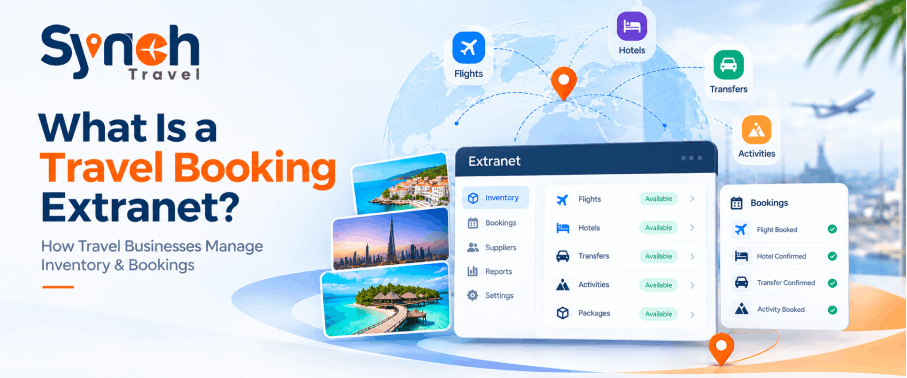
Running a travel business means tracking much more than bookings. You manage products, update rates, check availability, follow up with customers, work with agents, record payments, and send documents.
As the business grows, keeping all of this in different spreadsheets, emails, and systems becomes difficult. A rate changes in one place but not another. Customer information gets entered again for a new booking. An agent needs an update, but the latest booking details are sitting somewhere else.
This is where a travel booking extranet can make a difference. A travel booking extranet gives authorized users a central place to manage travel inventory, pricing, agents, customers, bookings, and the work that follows a booking.
For businesses looking for travel booking extranet software, it is also important to understand how an extranet fits with the rest of the booking setup. It is not the same as a booking engine, and it does not replace a travel API. Each has a different role.
So, what exactly does a travel booking extranet do, and where does it fit into the way a travel business sells and manages travel?
What Is a Travel Booking Extranet?
A travel booking extranet is a web-based system that authorised users can access to manage the information behind a travel business's sales and bookings.
Think of it as the working side of the operation that sits behind the booking experience.
When an agent books a hotel through a B2B portal or a traveller books a transfer through a B2C website, the booking itself is only one part of the process. The business may still need to manage the inventory, pricing, customer details, payment, documents, and booking status.
An extranet provides a central environment for that work.
The exact features depend on the business. A tour operator may need to manage packages, rates, and availability. A DMC may work with hotels, transfers, excursions, and activities. A B2B travel business may also need agent accounts, sub-agent access, commissions, pricing rules, and balances.
The common purpose is simple: give the team better control over the information and processes behind travel sales.
What Can a Travel Extranet Manage?
The scope of travel booking extranet software varies from one business to another. Some systems focus mainly on inventory, rates, users, and bookings, while broader travel management platforms can also connect CRM, quotations, payments, documents, and reporting.
Travel Inventory
A travel business may sell flights, hotels, transfers, tours, activities, excursions, or complete packages.
The inventory can come from different sources. Some products may be added directly by the business, while others may come through connected travel APIs.
A travel inventory system brings those products into a place where the team can work with the information they need for sales and bookings. Instead of checking one source for a hotel, another for a transfer, and a separate file for package information, the relevant inventory can be managed through the same system.
Availability, Rates and Pricing
Travel rates and availability can change frequently, so the team needs current information when preparing a quote or confirming a booking.
A travel booking extranet gives your team one place to manage these details.
Net Rate → Add Markup → Selling Price
If you sell through travel agents, you can also set the pricing or commission that applies to each agent.
This gives your team a clear way to manage prices and know what to charge when an agent or customer makes a booking.
Agents and Customers
For B2B businesses, agent management can be an important part of the system.
The business may need to create agent accounts, manage sub-agents, control access, apply pricing or commission rules, and keep track of bookings and balances. A B2B travel booking portal can then give those agents access to the products and prices they are allowed to book.
Customer information is just as important on the B2C side.
If someone has already booked with the business and comes back for another trip, the team should not have to start with an empty record. Existing customer details can be used when preparing a new quotation or booking.
This is one reason a travel agency booking system often needs more than a booking interface. The team needs access to the information surrounding the booking as well.
Bookings, Payments and Documents
Getting the booking confirmed is only one part of the job.
There may still be payments to collect, invoices to issue, balances to check, and travel documents to prepare. The team may also need to go back to the booking later to check what was paid, what remains outstanding, or what documents have already been sent.
A travel booking management system can keep these records together with the booking itself.
That gives the team a clearer view of what has happened and what still needs attention, rather than making them search through emails, spreadsheets, or separate systems.
Packages and Quotations
Tour operators and DMCs often sell combinations of services rather than individual products.
A package builder can bring hotels, transfers, tours, activities, and other services into one itinerary. The business can then prepare a quotation around those selected services and turn an approved quote into a booking.
This connects the work before the booking with the booking itself instead of requiring the team to recreate the information.
How Does a Travel Booking Extranet Work?
The workflow will vary from one business to another, but the basic process is:
Connect or Add Inventory → Manage Availability & Pricing → Sell Through B2B/B2C Channels → Receive Booking → Manage the Booking
The business first brings its products into the system, either by adding its own inventory or connecting supplier content through travel API integration.
The team can then work with availability, rates, pricing, and the other details needed to sell those products.
From there, the inventory can be made available through the right sales channel. An agent may access it through a B2B travel booking portal, while a customer may search and book through a B2C website.
Once the booking comes in, the work continues. Payment information, invoices, balances, customer details, and travel documents may all need attention.
This is why a travel booking extranet is more than a place to store products. It supports the work that happens around the booking as well.
How Does It Support B2B and B2C Travel Sales?
The same inventory can often be sold through both B2B and B2C channels, but the experience is different for agents and direct customers.
B2B Travel Booking Portal
An agent can log into a B2B travel booking portal, search available products, see the pricing applicable to their account, and make a booking.
Behind that portal, the business may manage:
- Agent accounts.
- Pricing and commissions.
- Access permissions.
- Credit or account balances.
- Inventory.
- Booking records.
The portal is the agent-facing side. The management environment gives the travel business control over the products, prices, users, and bookings behind it.
B2C Booking Website
The B2C journey is customer-facing. A traveller can search for a hotel, flight, transfer, activity, tour, or package, select an option, enter their details, and complete the booking online.
The customer sees the B2C booking website and booking interface.
Behind it, the business still needs to manage the inventory, pricing, customer information, booking, payment, and documents. The booking engine and management environment therefore work together as part of the same booking workflow.
Travel Booking Extranet vs. Booking Engine
It is easy to confuse a travel booking extranet with a travel booking engine because they are closely connected, but they are doing different jobs.
Travel Booking Extranet | Booking Engine |
| Used by the business and authorized users | Used by agents or customers to search and book |
| Manages inventory and availability | Displays available travel options |
| Handles rates, markups, and commissions | Shows the applicable selling price |
| Manages agents, customers, and bookings | Collects traveller or agent details |
| Supports payments, invoices, and documents | Takes the user through the booking process |
The booking engine is the part people use to search and book. The extranet is where the business manages much of the work behind that experience.
They work together, but they are not the same system or function.
Travel Booking Extranet vs. Travel API
A travel API serves a different purpose.
A travel API connects travel content and booking functionality between systems, while a travel booking extranet gives users a place to manage products, pricing, users, and bookings.
A typical setup can look like this:
Travel APIs + Your Inventory → Travel Management System / Extranet → B2B & B2C Booking Channels → Booking → Back-Office Operations
This is why an API does not replace an extranet. One connects systems; the other provides a place for people to work with the information.
What Should You Look for in Travel Booking Extranet Software?
If you are comparing travel booking extranet software, start with the way your team actually works.
Does the system handle the products you sell? Can you connect the APIs you need? Can you control pricing for different agents? Can your team manage quotations, bookings, payments, and documents without moving between several systems?
These questions are often more useful than simply looking at a feature list. The right travel booking software should fit the way your business handles inventory, sales, bookings, and day-to-day operations.
Depending on your business, you may want a system that can:
- Manage different travel products.
- Handle availability and rates.
- Apply markups and commissions.
- Connect with travel APIs.
- Support B2B and B2C sales.
- Provide agent and sub-agent access.
- Store customer and lead information.
- Manage quotations and packages.
- Track bookings, payments, invoices, and balances.
- Manage travel documents.
- Provide reports and operational visibility.
- Reduce repeated data entry.
- Grow with your inventory and booking volumes.
The important thing is to look at the whole workflow, not just whether a system has something called an “extranet.”
How SynchTravel Fits Into the Extranet Workflow
SynchTravel brings the different parts of that workflow together in one travel management platform.
A business can connect its inventory, manage products and pricing, sell through B2B and B2C channels, and continue managing the booking once the sale is made.
The workflow can look like:
Connect Inventory → Manage Products & Availability → Set Pricing → Sell Through B2B/B2C Channels → Manage Bookings → Handle Payments, Documents & Customers
With SynchTravel, businesses can:
- Manage travel inventory across flights, hotels, transfers, activities, excursions, tours, and packages.
- Connect their own supported travel APIs alongside the APIs available through SynchTravel.
- Manage availability and pricing using the net rate → markup → commission → selling price workflow.
- Manage B2B sales through agent and sub-agent portals with pricing, commission, access, and account controls.
- Support B2C sales through a customer-facing bookable website.
- Manage quotations and packages by bringing different travel services together into one itinerary.
- Keep customer, booking, payment, invoice, balance, and document information together as part of the booking workflow.
- Reduce repeated work across quotations, packages, customer records, and booking management.
This gives travel agencies, tour operators, OTAs, DMCs, and other B2B travel businesses a single place to manage the work behind their booking channels.
Rather than having the team move between separate tools to manage each part of the booking, Synch Travel brings these workflows together within one travel management system.
Ready to Bring Your Travel Operation Together?
Your booking website or agent portal handles the selling experience. Behind that, your team still needs to manage inventory, pricing, bookings, customers, payments, and documents.
Schedule a demo with SynchTravel to see how one travel management platform can support your booking and operations workflow.
FAQs
1) What is a travel booking extranet?
A travel booking extranet is a web-based system that authorised users can access to manage travel inventory, availability, pricing, agents, customers, bookings, and related operations.
2) How does a booking extranet work?
A booking extranet brings inventory into a central management system, either through direct entry or connected APIs. The business can then manage availability, rates, pricing, users, bookings, payments, and other information around the booking.
3) What is travel booking extranet software?
Travel booking extranet software is used by travel businesses to manage the products, pricing, users, and booking information behind their B2B and B2C sales channels.
4) What type of inventory system do travel agents use?
Travel agents can use a travel inventory system to manage products such as flights, hotels, transfers, tours, activities, excursions, and packages, along with their rates, availability, and bookings.
5) What is a travel booking platform for businesses?
A travel booking platform brings areas such as inventory, pricing, bookings, CRM, payments, and back-office operations together so a travel business can manage its sales and bookings in one system.
6) What is the difference between a travel booking extranet and a booking engine?
A travel booking extranet is used to manage inventory, pricing, users, and bookings, while a travel booking engine provides the search and booking experience for agents or customers.
7) What is the difference between a travel API and a travel booking extranet?
A travel API connects travel content and booking data between systems, while a travel booking extranet gives travel businesses a place to manage that information, including inventory, pricing, users, and bookings.
8) Is a travel booking extranet the same as a travel management system?
Not necessarily. An extranet is generally the management environment used by authorized users, while a travel management system can cover a broader set of functions, including inventory, pricing, CRM, quotations, bookings, payments, documents, reporting, and sales channels.
Share Blog
Curious How SynchTravel Works in Real Time?
Explore how travel professionals are streamlining operations and growing faster with SynchTravel.
Book a Demo

