
 Synch AI
How to Scale Your Travel Agency: Common Growth Challenges and the Technology That Solves Them
Struggling to manage growth? Discover the common challenges travel agencies face and how modern travel technology helps streamline operations and scale efficiently.

What if your travel agency is growing… but your operations are not ready for it?
At first, everything feels like it's moving in the right direction. More enquiries start coming in, bookings increase, and revenue begins to grow. That's exactly what every travel agency works towards.
But as your agency gets busier, every booking also brings more quotations to prepare, more supplier coordination, more follow-ups, and more customer messages to handle. Soon, your team spends more time managing daily operations than actually growing the business.
This is usually the point where travel agencies realize that growth and scalability are two very different things. Winning more bookings is one challenge.
Learning how to scale your travel agency without increasing manual work, operational costs, and complexity is another.
What works for a small number of bookings often doesn’t work when volumes grow. Inquiries become harder to track, quotations take longer, and information gets scattered across different systems, making daily operations harder to manage. Without proper processes and technology, growth quickly turns into bottlenecks instead of smooth progress.
The good news is these are common growing pains. The key is identifying them early and fixing them before they limit your growth. Before exploring the challenges, let’s understand what scaling really means for a travel agency.
What Does It Mean for a Travel Agency to Scale?
Many travel agency owners assume that if bookings are increasing, their business is scaling. In reality, growth and scalability are not the same thing.
Growth means generating more bookings and increasing revenue. Scalability means handling that extra demand without increasing the same level of manual work, operating costs, or operational complexity. To scale your travel agency successfully, your operations need to become more efficient as demand grows, not simply bigger.
Think about it this way. If your bookings double but your team also has to work twice as hard, your agency is growing, but it isn't scaling. A travel agency scaling relies on efficient processes and connected systems so that growth doesn't automatically create more work.
The warning signs usually appear gradually. Quotations take longer to prepare, customer inquiries become harder to track, information is spread across different tools, and managers spend more time solving operational issues than planning future growth. These are clear indicators that your agency has outgrown its existing processes.
The good news is that these challenges are not unique. They're common growing pains for travel agencies, and understanding them is the first step towards building a business that's ready for sustainable growth.
Common Challenges That Prevent Travel Agencies from Scaling
As travel agencies grow, daily operations become harder to manage across enquiries, bookings, and suppliers. What once worked with simple tools and manual processes starts to break under higher demand. Delays, scattered information, and communication gaps begin to appear in everyday work. These operational issues become the main barriers that prevent travel agencies from scaling smoothly.
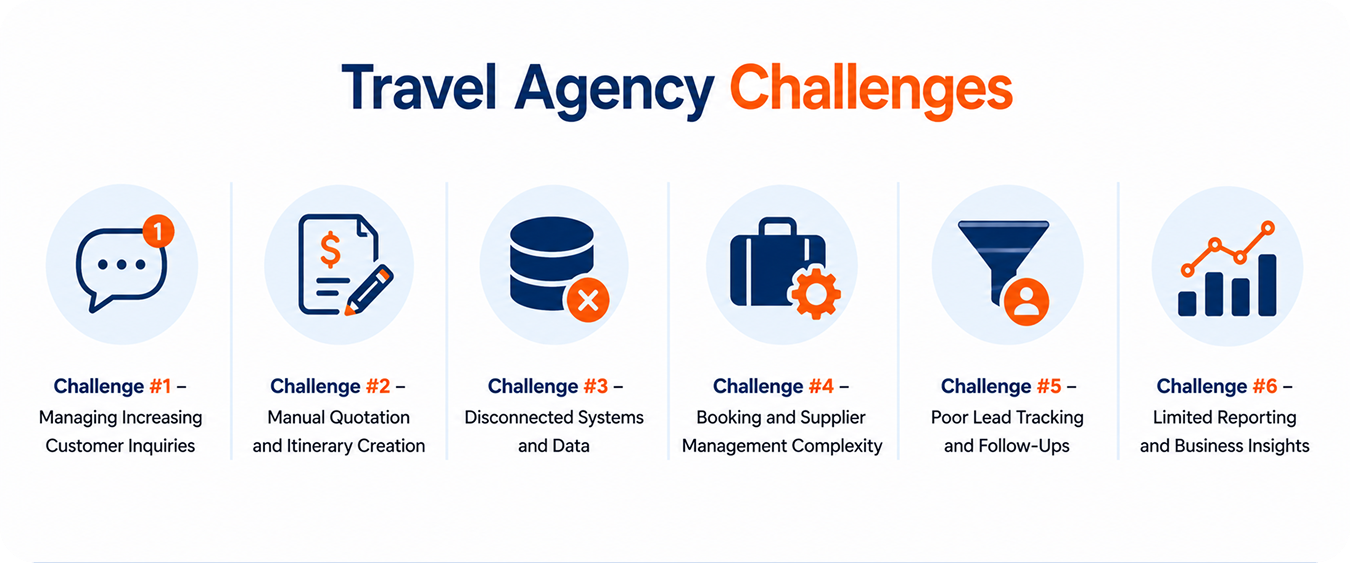
Challenge #1 – Managing Increasing Customer Inquiries
As your agency grows, inquiries start coming from multiple channels, including your website, email, social media, referrals, and messaging apps. While this increase is a positive sign, managing every lead manually becomes increasingly difficult. Without a structured process, responding quickly and consistently becomes a challenge, making it harder to scale your travel agency successfully.
- High Volume of Leads: More inquiries mean more opportunities, but they also increase the workload for your sales team. Without proper organization, important leads can easily be overlooked.
- Delayed Responses: Customers expect quick replies when planning a trip. Slow response times can reduce trust and encourage travelers to contact another agency.
- Lost Booking Opportunities: Every missed or forgotten inquiry is a potential booking lost. Delayed communication often leads customers to choose competitors that respond faster.
- Impact on Conversion Rates: As response times increase, enquiry-to-booking conversions typically decrease, limiting revenue even as more leads come in.
Challenge #2 – Manual Quotation and Itinerary Creation
Preparing customized travel quotations manually may work for a few inquiries, but it quickly becomes time-consuming as booking requests increase. Agents spend hours collecting supplier rates, calculating prices, and preparing itineraries instead of focusing on customers.
- Time-Consuming Quotation Process: Creating every quotation from scratch slows down the sales cycle and limits how many inquiries each consultant can handle.
- Inconsistent Pricing: Different team members may calculate prices differently, leading to inconsistent quotations and reduced profit margins.
- Human Errors: Manual calculations and repeated data entry increase the chances of incorrect prices, travel dates, or booking details.
- Difficulty Handling Multiple Requests Simultaneously: During busy travel seasons, preparing several quotations at once becomes difficult, creating delays for customers waiting to make a booking.
Challenge #3 – Disconnected Systems and Data
Many agencies rely on different tools for bookings, emails, accounting, spreadsheets, and customer records. While each system serves a purpose, managing them separately creates unnecessary complexity as the business grows.
- Separate Tools for CRM, Bookings, Accounting, and Communication: Switching between multiple platforms wastes time and makes daily tasks more complicated than they need to be.
- Duplicate Data Entry: Customer information often has to be entered repeatedly across different systems, increasing workload and the risk of inconsistencies.
- Lack of Visibility Across Operations: When information is scattered, managers struggle to track bookings, inquiries, staff performance, and business progress from one place.
- Operational Inefficiencies: Disconnected systems slow workflows, reduce productivity, and make everyday operations harder to manage.
Challenge #4 – Booking and Supplier Management Complexity
Every booking requires the coordination of multiple travel services, such as flights, hotels, transfers, tours, and other suppliers. As the number of bookings grows, managing these arrangements manually becomes more harder.
- Managing Hotels, Flights, Transfers, and Tours: Each booking requires careful coordination among multiple suppliers, making the process more time-consuming.
- Supplier Communication Issues: Relying on emails and phone calls for supplier updates can result in delays, missed confirmations, or overlooked updates.
- Booking Errors: Manual coordination increases the possibility of incorrect reservations, duplicate bookings, or missing travel documents.
- Coordination Challenges: Keeping every supplier, booking, payment, and customer update organized becomes much harder as operations expand.
Challenge #5 – Poor Lead Tracking and Follow-Ups
Getting inquiries is only the beginning of the sales journey. Without a reliable follow-up process, valuable leads can easily be forgotten before they become paying customers.
- Missed Opportunities: Failing to follow up at the right time often results in customers booking elsewhere.
- Lack of Sales Pipeline Visibility: Without a structured sales pipeline, it becomes difficult to see which inquiries are progressing and which require immediate attention.
- Difficulty Monitoring Team Performance: Managers have limited visibility into response times, follow-up activities, and individual consultant productivity.
- Customer Retention Challenges: Poor communication after the initial inquiry can reduce customer confidence and make repeat bookings less likely.
Challenge #6 – Limited Reporting and Business Insights
Making informed business decisions needs accurate data. However, many growing agencies try to collect meaningful insights because their information is spread across multiple platforms.
- Difficulty Measuring Performance: Without clear reporting, it becomes difficult to evaluate sales, bookings, or overall business performance.
- Lack of Real-Time Data: Delayed or outdated information prevents agencies from responding quickly to operational changes.
- Inability to Identify Growth Opportunities: Limited reporting makes it harder to recognize profitable destinations, top-performing services, or emerging customer trends.
- Decision-Making Based on Assumptions: Instead of relying on reliable data, agencies often make important business decisions using estimates or incomplete information.
How Technology Helps Travel Agencies Scale Efficiently
The challenges discussed above often have one thing in common, they're caused by manual processes and disconnected systems. As booking volumes grow, relying on spreadsheets, emails, and multiple software applications makes it increasingly difficult to manage daily operations efficiently.
If you're wondering how to scale a travel agency, the answer often starts with replacing fragmented workflows with an integrated travel technology platform. Instead of switching between different systems, teams can manage inquiries, quotations, bookings, customer records, and supplier information from one centralized system.
That's exactly what SynchTravel was built to do. It brings every part of your travel business together in one connected platform, helping agencies centralize operations, automate repetitive tasks, improve collaboration, and spend less time on administration while delivering exceptional customer experiences.
- Automation of Repetitive Tasks: Routine activities such as sending follow-up emails, generating quotations, updating booking records, and sharing travel documents can be automated. This reduces manual effort, minimizes errors, and allows teams to focus on higher-value tasks.
- Centralized Management Systems: Managing customer information, bookings, quotations, and suppliers from one platform improves visibility across the business. Everyone works with the same data, making day-to-day operations more organized and efficient.
- Faster Customer Service: Consultants can prepare proposals more quickly, answer questions more quickly, and keep clients informed at every stage of the process without delays when information is easily accessible.
- Improved Operational Efficiency: Automated workflows reduce duplicate tasks, streamline internal processes, and help agencies handle increasing booking volumes without adding unnecessary complexity.
- Improved Teamwork: Teams can instantly access the same data on a shared platform. This enhances communication and guarantees that work proceeds without hiccups even when duties are divided.
Key Technologies Driving Travel Agency Growth
Choosing the right technology is more than just eliminating manual labor; it is about discovering solutions that truly make a difference. The most effective tools can help you work more efficiently, provide better customer service, and lay the groundwork for long-term growth in your business. Here are some key technologies that can make modern travel agencies more efficient and effective.
Travel CRM Systems
A dedicated travel CRM is one of the most valuable features of modern travel agency management software. Instead of relying on spreadsheets or scattered records, consultants can manage customer inquiries, interactions, bookings, and follow-ups from one place, giving the entire team better visibility throughout the sales journey.
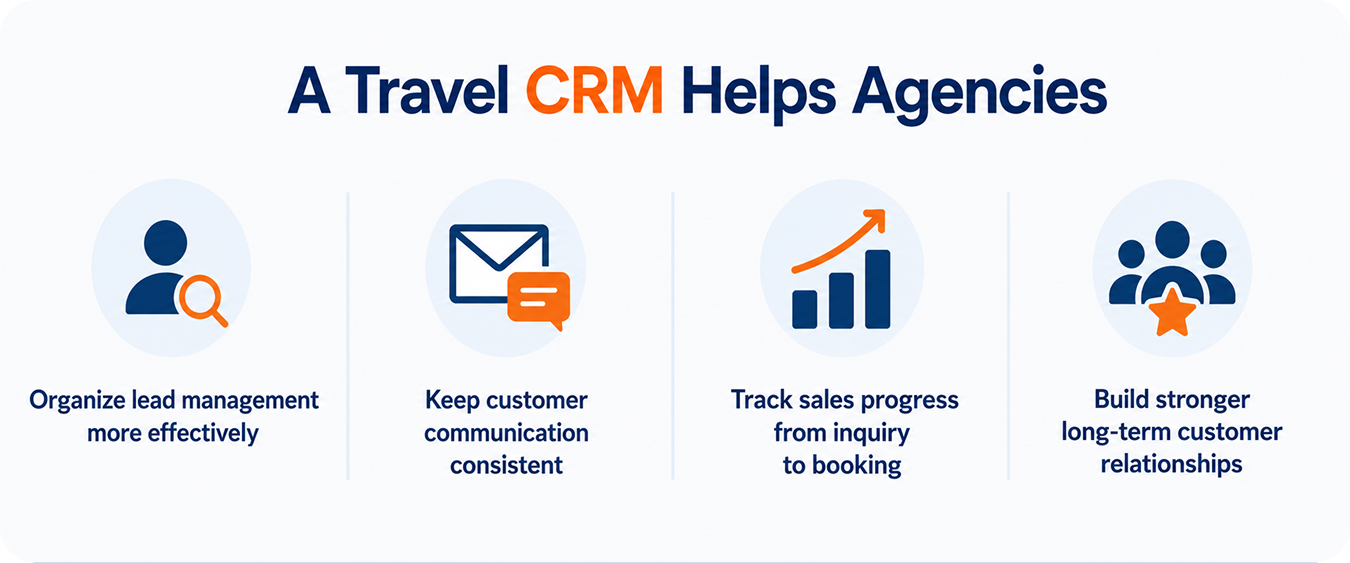
A travel CRM helps agencies:
- Organize lead management more effectively: Every inquiry is stored in one place, making it easier to track prospects and ensure no potential customer is overlooked.
- Maintain consistent customer communication: Each customer profile consists of all emails, messages, and previous conversations, so the consultants can offer personalized service.
- Track sales progress from inquiry to booking: Managers can see where each lead is in the sales pipeline and identify opportunities that require follow-up.
- Build stronger long-term customer relationships: Having complete customer history readily available helps agencies deliver a more personalized experience and encourage repeat bookings.
Automated Quotation and Itinerary Tools
Creating travel quotations manually often slows the sales process and increases the possibility of errors. Travel agency automation helps simplify this process by generating professional quotations and itineraries faster, reducing manual work while maintaining consistency across every proposal.
With SynchTravel's quotation and itinerary management tools, agencies can prepare customized proposals in less time and provide customers with a more professional booking experience.
Key benefits include the following:
- Faster proposal creation: Rather than starting from scratch, consultants can generate customized quotations in minutes.
- Better pricing accuracy: Automated calculations will help in reducing pricing variations and minimizing manual errors.
- Professional itineraries: Well-designed travel plans present information clearly, making it easier for customers to review their trip details.
- Better customer experience: Faster turnaround times and polished proposals help build confidence and support quicker booking decisions.
B2B and B2C Booking Platforms
As your travel agency grows, managing bookings across multiple sales channels becomes more challenging. An integrated B2B travel portal & B2C travel portal allows travel partners and direct customers to book online while keeping markups, pricing, bookings, customer data, and website activity automatically synchronized with one central management system. This reduces manual work and gives your team complete control from a single platform.
Benefits include:
- Online booking capabilities: Customers and travel partners can search and submit bookings without relying entirely on manual assistance.
- Self-service booking options: Users can access available travel products, review pricing, and complete bookings whenever it is convenient for them.
- Revenue growth opportunities: Agencies supporting multiple sales channels have the potential to reach a broader audience and increase booking potential.
- Simplifies booking management: From a single platform, B2B and B2C booking management reduces administrative work and improves consistency.
API Integrations
Agencies with increased booking volumes require access to live travel inventory. API integrations allow agencies to connect directly with travel suppliers for real-time information without visiting multiple websites.
SynchTravel supports travel API integrations, which make booking management easier while improving pricing accuracy and operational efficiency.
Key advantages include the following:
- Live inventory access: Consultants can check the latest flight, hotel, and travel availability without manually contacting suppliers.
- Real-time pricing updates: Current pricing is displayed automatically, helping agencies provide accurate quotations and reduce pricing discrepancies.
- Faster booking confirmations: Direct supplier connections speed up the reservation process, allowing bookings to be confirmed more efficiently.
- Streamlined booking processes: Automated data exchange reduces manual work and helps consultants complete bookings more quickly.
AI and Workflow Automation
AI-powered automation reduces repetitive administrative work by completing routine tasks automatically. This allows travel consultants to dedicate more time to customer service and business development.
With SynchTravel, agencies can automate key operational activities while maintaining a consistent customer experience.
Examples include:
- Automated follow-ups: Reminder emails and customer communications can be scheduled automatically, ensuring every lead receives timely attention.
- Customer support assistance: AI-powered tools help answer common customer queries, allowing consultants to focus on more complex requests.
- Booking reminders and notifications: Automated alerts keep customers informed about payments, travel documents, and upcoming departures.
- Improved operational efficiency: Reducing repetitive manual tasks allows teams to manage more bookings without increasing administrative workload.
Building a Scalable Travel Business: Best Practices
Buying software is a great first step, but you also need a good plan. Use these simple best practices to get your travel agency digital transformation started:
| What to Do | How to Do It |
| Standardize Workflows | Write down a clear step-by-step guide for your sales process. Make sure every agent handles a new lead the exact same way. |
| Business Operations | Require your team to keep all emails, invoices, and vouchers inside your central system. Stop using personal notebooks or desktop folders. |
| Workflow Automation | Do not wait until your team is completely burned out. Set up automated follow-ups and quote tools while you still have time to learn them. |
| Sales Reports | Look at your sales reports every week. See which destinations are making the most money and spend your marketing budget there. |
| Client Service | Use the hours you save from automation to give your clients amazing, personalized service that automated travel apps cannot match. |
Following these best practices gives your business a stronger foundation for long-term growth. Combined with the right technology, they make it easier to scale your travel agency while keeping operations organized and your team focused on delivering exceptional customer experiences.
Agencies That Lead Tomorrow Are Preparing Today with SynchTravel
The travel industry continues to evolve, and customer expectations continue to rise. Agencies that embrace smarter technology today will be better positioned to deliver faster service, stronger customer experiences, and sustainable growth tomorrow.
In this guide, we've explored how lead management, quotations, bookings, supplier coordination, reporting, and automation contribute to building a more efficient and scalable business. If you're looking to scale your travel agency, bringing these processes together is one of the most effective ways to support long-term growth.
That's why many growing agencies are investing in travel technology solutions that bring every part of their business together. SynchTravel does exactly that, helping you streamline operations, improve collaboration, and grow with confidence through one connected platform.
Your Agency Is Growing. Is Your Technology Keeping Up?
As bookings increase, so does operational complexity. SynchTravel helps travel agencies simplify workflows, automate routine tasks, and scale efficiently without adding unnecessary overhead.
Request a demo and see SynchTravel in action.
FAQs
How can I scale my travel agency successfully?
Scale your travel agency by automating workflows, centralizing operations, and using platforms like SynchTravel to manage growth more efficiently.
What are the biggest challenges when scaling a travel agency?
Growing agencies often struggle with manual bookings, quotations, supplier coordination, lead management, and disconnected systems that slow operations.
What software should a growing travel agency use?
Choose software with CRM, booking management, itinerary creation, automation, reporting, API integrations, and supplier management for smoother operations.
How can travel technology improve operational efficiency?
Travel technology reduces manual work, improves team collaboration, speeds up customer responses, and simplifies booking and supplier management.
Why is travel agency management software important for scaling?
Travel agency management software centralizes operations, automates repetitive tasks, improves customer service, and helps agencies manage higher booking volumes without significantly increasing staff or operational costs.
Share Blog
Curious How SynchTravel Works in Real Time?
Explore how travel professionals are streamlining operations and growing faster with SynchTravel.
Book a Demo

